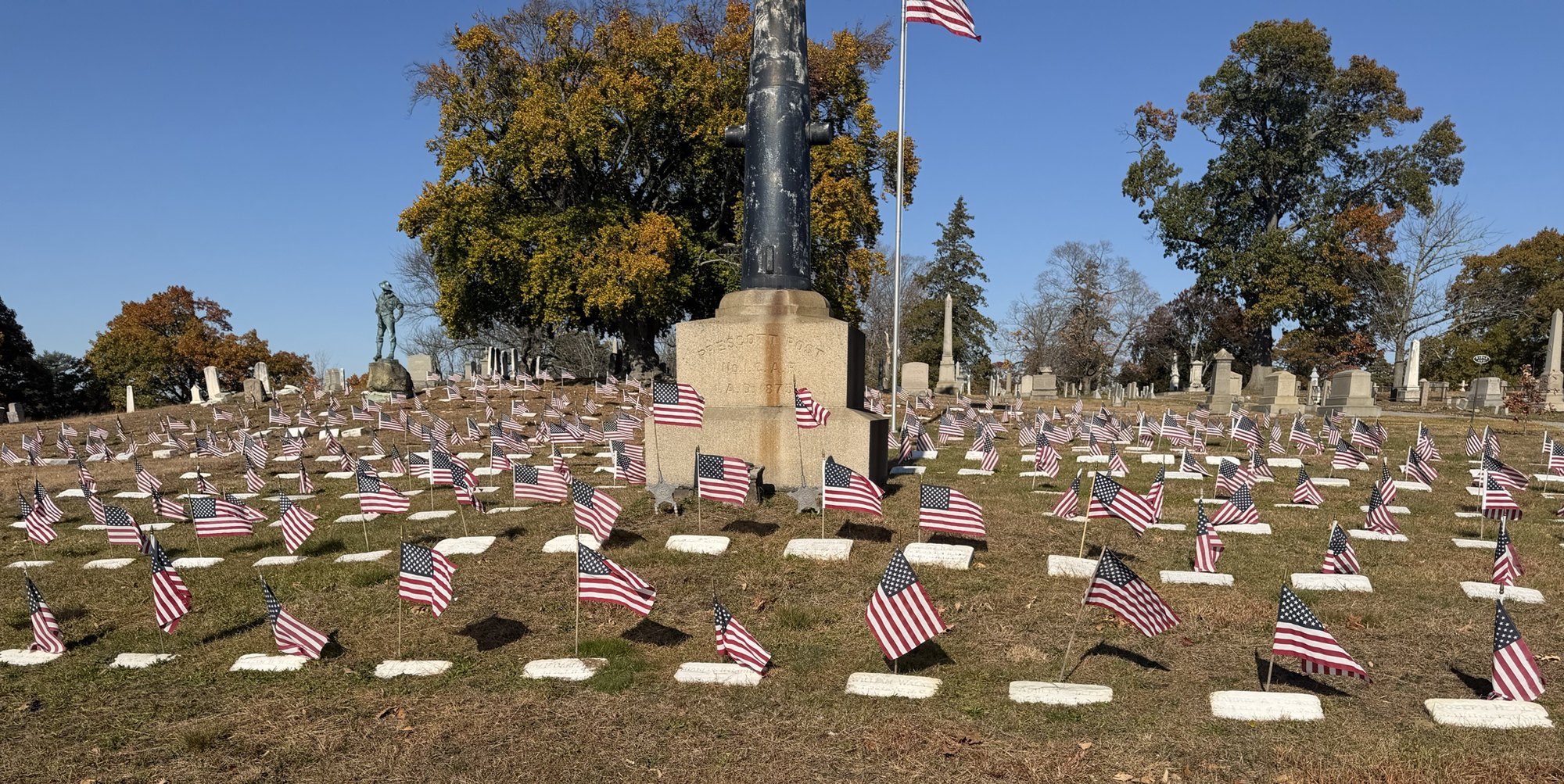
The lot from its downhill end, looking up the slope over the rows to the monument: an old cannon set upright on a granite base. About the monument → Photograph by Bernard Brennan, 2026.
You are standing in a burial lot of the Grand Army of the Republic, the organization of Union veterans. The monument at its centre reads "Prescott Post, No. 1, G.A.R., A.D. 1875." [1] It has a page of its own. Around it stand about three hundred small white government headstones in rows. [2] The earliest death carved on them is 1876; the latest are in the 1930s. [2]
How the lot began
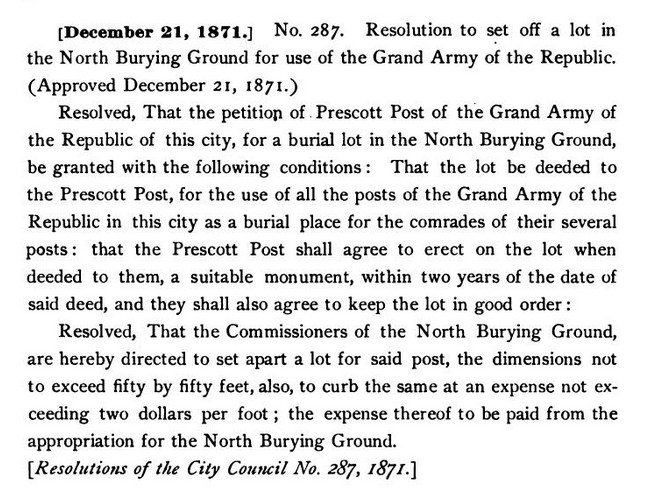
In 1871 Prescott Post asked the City of Providence for a burial lot here. On December 21, 1871, the City Council granted it. The first condition was that the lot be deeded to Prescott Post "for the use of all the posts of the Grand Army of the Republic in this city as a burial place for the comrades of their several posts." [9]
The grant: Resolution No. 287 of the Providence City Council, approved December 21, 1871, as printed. [9]
One of those posts was Ives Post No. 13, a post of Black veterans, chartered in 1868. [4] The grant does not mention race. It names every post, and Ives Post was one of them. [9][4]
The Post dedicated the monument on Decoration Day, Saturday, May 29, 1875. Its shaft is an old 32-pounder cannon, ten and a half feet long, that Congress voted to the Post. It stands on a base of Westerly granite. [3] The monument page has the Act of Congress and the rest of its story.
Who is here
Every stone marks a man who served the Union in the Civil War: in regiments from Rhode Island, Massachusetts, Connecticut, Maine, New York, Pennsylvania and a dozen other states, in the regular army, and in the Navy. [2] Among them are men of the 14th Rhode Island Heavy Artillery (Colored), the state's Black regiment, and of the 55th Massachusetts, the 29th Connecticut, and more than a dozen regiments of United States Colored Troops. [2] By June 2025, fifty-two of the men buried here had been identified as Black veterans. [5]
They lie in the same rows. A corporal of the 14th Rhode Island is next to a sailor; a private of the 1st U.S. Colored Infantry is next to a man of the 2nd Rhode Island. [2] The stones themselves say nothing about race. They give a name, a company, a regiment, and a date of death. [2]
What the City did
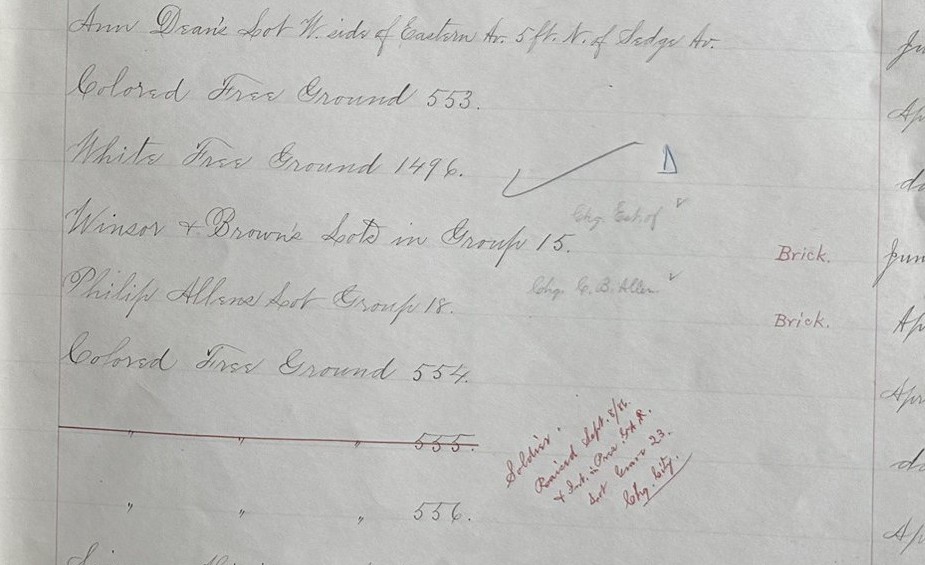
The City kept its own burial grounds differently. In 1883 its free burials, for those whose families could not pay, ran in two numbered series: a White Free Ground and a Colored Free Ground. [6]
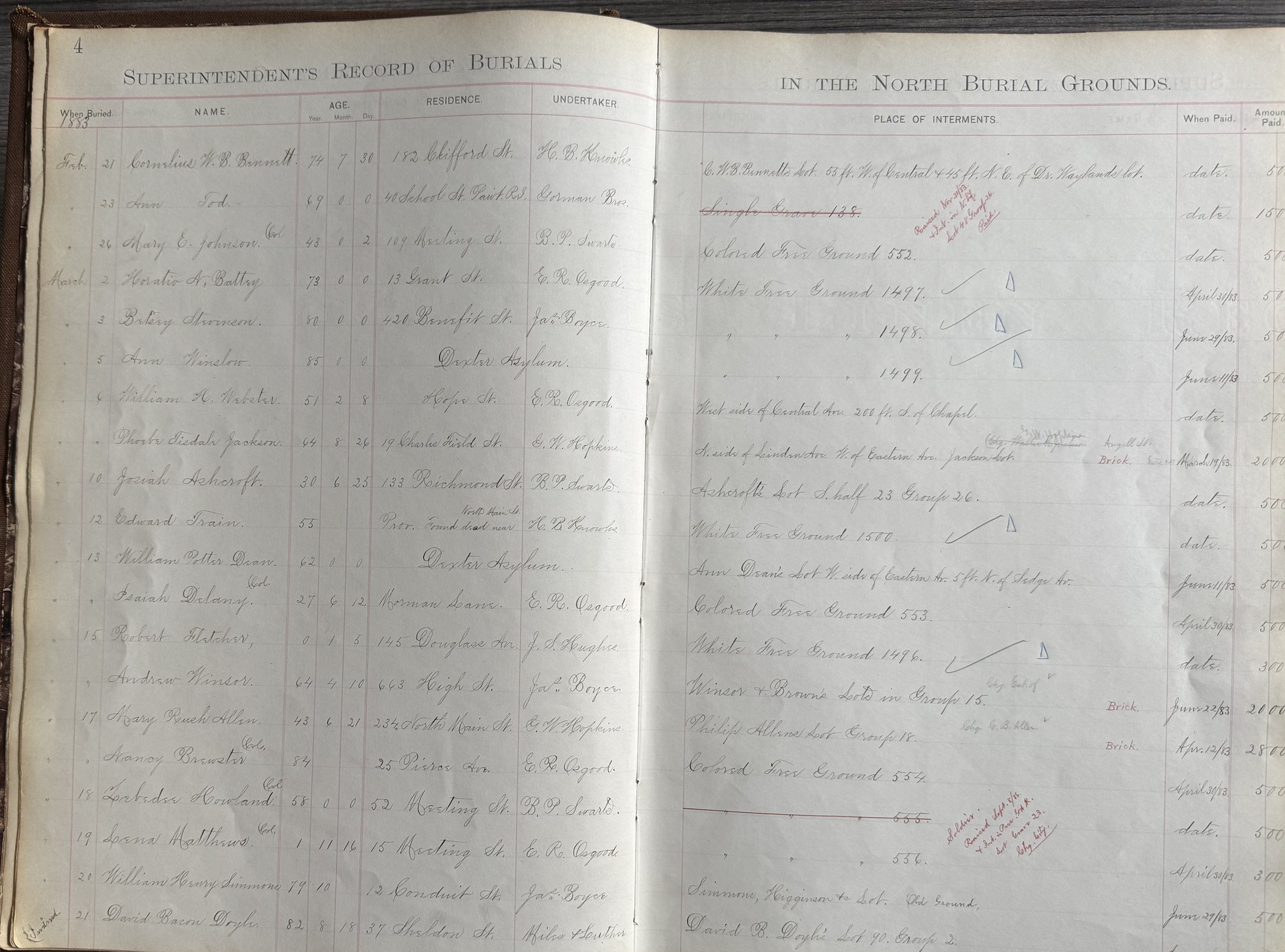
The City's burial ledger, March 1883, place-of-interment column. Free burials are entered by series and grave number: "Colored Free Ground 553," "White Free Ground 1496," "Colored Free Ground 554." The struck line, ditto marks for "Colored Free Ground 555," is Zebedee Howland's; the red note beside it reads "Soldier. Raised Sept. 8/86 & Int. in Prov. G.A.R. Lot Grave 23. Chg. City." See the whole page. Courtesy City of Providence, Department of Parks, North Burial Ground. [6]
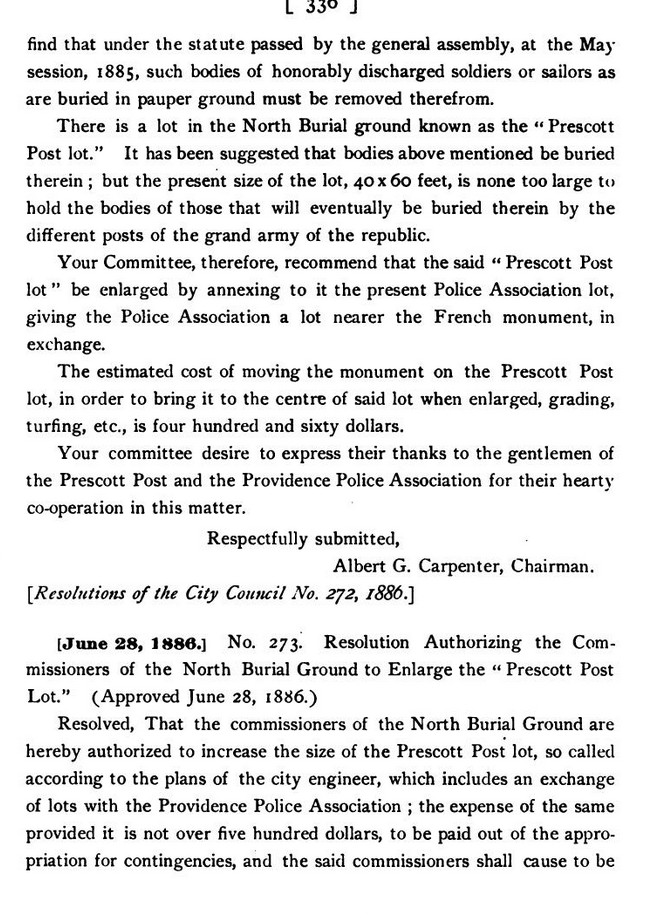
In 1885 the General Assembly passed a law: honorably discharged soldiers and sailors buried in pauper ground had to be moved out of it. [7] The City's committee on the North Burial Ground found this lot too small to take them. In June 1886 the City Council voted to enlarge it by annexing the Providence Police Association's lot, and to move the monument to the centre of the larger lot. [7]
The joint committee's report (No. 272) and the Council's Resolution No. 273 of June 28, 1886, as printed: the enlargement of the lot and the moving of the monument. [7]
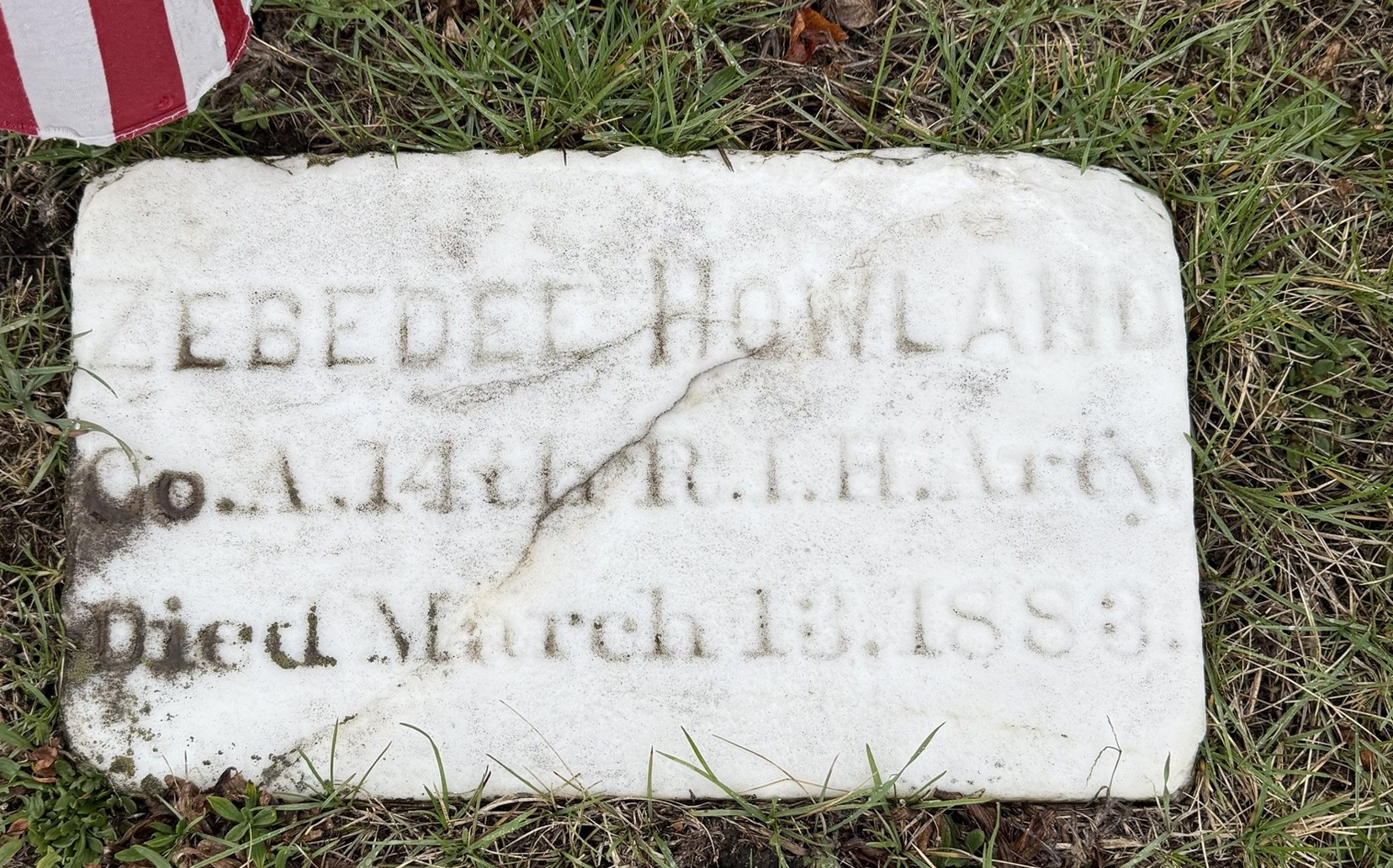
Zebedee Howland, sergeant major of the 14th Rhode Island, had died in March 1883. The City buried him in the Colored Free Ground. On September 8, 1886, ten weeks after the City authorized the enlargement, his body was raised and reburied here, at the City's charge. The clerk struck the old entry and wrote "Soldier" beside it. [6] His stone is at G3, and his page tells his story.
The stone of Zebedee Howland, G3: ZEBEDEE HOWLAND / Co. A. 14th R.I.H.Arty. / Died March 13, 1883. Read his page →
Howland's is the one case documented so far. The 1885 law makes it likely there were others, Black and white. The City's burial ledgers will show how many.
How the rows were filled
The dates on the stones run in order. Deaths of the 1870s and 1880s are in the rows nearest the monument. From there the dates run outward in both directions, a row at a time: the 1890s, the 1900s, the 1910s, and in the uphill rows the 1920s and 1930s. [2] From the 1890s on, the Post buried its men in the order they died, each in the next grave.
The oldest rows are less simple. The lot was enlarged and its monument re-centred after 1886, and men who had died years earlier were brought in that year. Where a man in those rows lies may depend on when he was reburied, not when he died. Nothing in the record found so far shows anyone was placed by race. The Post's own records, if they survive, are where that will be settled.
A caution
The men here are buried together. That does not mean they served together. Each stone's regiment is what the stone says; each man's service is what his record shows. Where this site tells you a man was Black, or white, or served in a particular unit, it is because a document says so, and the document is cited on his page. [8]
What this site is
Each stone has a page. It gives a short life of the man, the records that life rests on, and what is not known about him. About fifty of the three hundred have been identified from their stones and from the regimental rolls; a handful have been researched in the National Archives. [2] The rest are listed by what their stones say. The work is continuing, and the pages will change as it does.
The lot is cared for by the City of Providence, Department of Parks, North Burial Ground. The research is by the volunteers named on each page. Corrections are welcome.
The lot, row by row
The lot is on a slope. Row A is at the top; the rows run downhill from there. Pick a row to see its stones.
West · 1Uphill ↑25 · East
A
B
C
D
E
F
G
H
I
J
K
L
M
N
Schematic: places in order, not to scale. The monument stands in rows J and K; its exact place among their stones is still being fixed. 318 positions surveyed; 113 names read; 52 men identified; 113 pages.
Stone readIdentifiedLife draftedCompleteNot yet readMonumentFlagpole
Monument inscription, Prescott Post lot, North Burial Ground, Providence, R.I. Photograph by Bernard Brennan, 2026 (IMG_2584).
Prescott Post Digital Companion, Plot register (register.csv), surveyed and photographed by Bernard Brennan, 2025–2026; stone-by-stone transcriptions and photo references are in the register. Dated stones in grid order: row A 1919–1928; row B 1915–1919; row C 1912–1915; row F 1902–1904; rows G–I 1876–1889; rows J–K 1894–1898; row E 1905–1909; row M 1899–190?; row N 1928–1937.
"The Laureled Dead: Annual Observance of Decoration … Dedication of the Prescott Post Monument," Providence Morning Star, May 31, 1875, 1, including the report of the Post's building committee.
Andrew Evans, "Black Memory of the Civil War in New England, 1865–1877" (PhD diss., Brandeis University, 2026), 125 n. 187, 159–60. ⟨replace or supplement with a primary source for the 1868 charter: Department of R.I. proceedings or Ives Post records⟩
Jack Perry, "An Overdue Salute," Providence Journal, June 19, 2025, 1.
City of Providence, North Burial Ground, Superintendent's Record of Burials, 1883, entry of 18 March 1883 (Zebedee Howland), with marginal annotation of 8 September 1886; same page, series headings "White Free Ground" and "Colored Free Ground." Photograph by Bernard Brennan, 2026 (IMG_2550), courtesy City of Providence, Department of Parks, North Burial Ground. ⟨volume and page: ask A. Heppner⟩
City of Providence, ⟨title of printed volume⟩, 1886, No. 272, "Report of the Joint Committee on the North Burial Ground, relative to the Enlargement of the 'Prescott Post Lot,'" presented June 7, 1886, ⟨329⟩–330; No. 273, "Resolution Authorizing the Commissioners of the North Burial Ground to Enlarge the 'Prescott Post Lot,'" approved June 28, 1886, 330–⟨331⟩. ⟨page number is clipped in our copy of the page: 330 or 336; confirm⟩ ⟨Add the 1885 statute: R.I. Acts and Resolves, May Session 1885, chapter⟩
City of Providence, City Council, Resolution No. 287, "Resolution to set off a lot in the North Burying Ground for use of the Grand Army of the Republic," approved December 21, 1871; as printed in ⟨title of printed volume⟩.