The monument
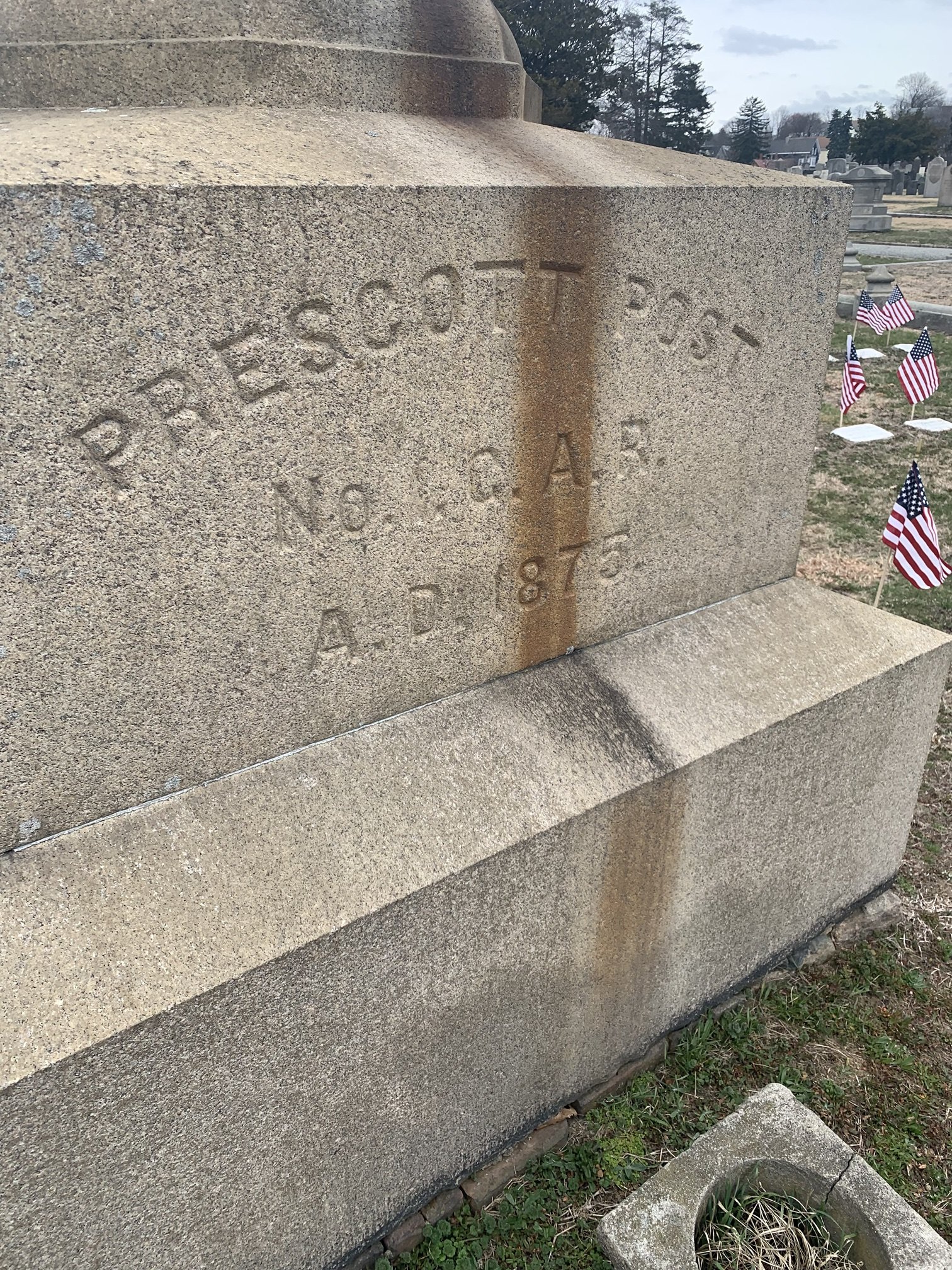
At the centre of the Prescott Post lot stands a granite base with an old cannon set upright on it. The base is cut on one face: PRESCOTT POST / No. 1. G.A.R. / A.D. 1875. [1] Everything else about it comes from the City's records, an Act of Congress, and the newspaper that reported the day it was dedicated.
The lot, 1871
Prescott Post No. 1 was the Providence post of the Grand Army of the Republic, the Union veterans' organization. In 1871 its committee on a burial lot — Comrades E. H. Rhodes, Ervin T. Case and Edwin C. Pomroy, later joined by William Frankland and James Warren — petitioned the City Council for ground in the North Burial Ground, and Comrade Case carried the petition. [2]
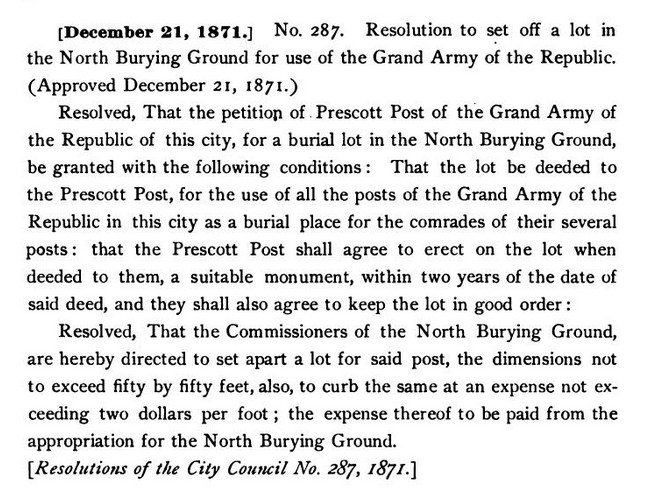
The Council granted it on December 21, 1871, by Resolution No. 287. The lot was to be deeded to Prescott Post "for the use of all the posts of the Grand Army of the Republic in this city as a burial place for the comrades of their several posts." Its size was not to exceed fifty feet by fifty. The City would curb it at a cost of up to two dollars a foot. In return the Post agreed to erect "a suitable monument" within two years of the deed, and to keep the lot in good order. [3]
The gun, 1874
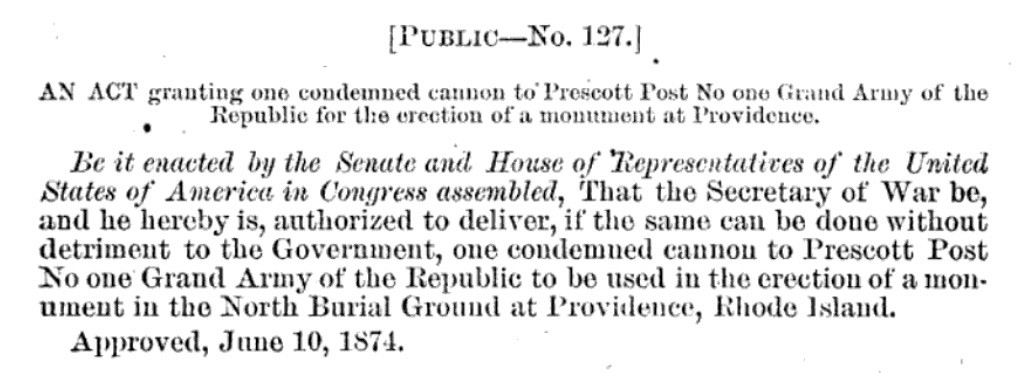
The monument's shaft is a condemned cannon, and the Post got it from the United States. On June 10, 1874, Congress passed Public Act No. 127, "An Act granting one condemned cannon to Prescott Post No. one Grand Army of the Republic for the erection of a monument at Providence." It authorized the Secretary of War to deliver the cannon, "if the same can be done without detriment to the Government," to be used "in the erection of a monument in the North Burial Ground at Providence, Rhode Island." [4]
The Act names no gun. Which cannon the War Department sent, from which arsenal or fort, and what is stamped on it, are questions for the gun itself and for the Ordnance records; see What we don't know.
The dedication, May 29, 1875
The Post dedicated the monument on Decoration Day, Saturday, May 29, 1875, marching to the ground with the American Band and a detachment of the Marine Artillery under Lieutenant Abbott. The band played "Rest, Spirit, Rest"; the Post chaplain, the Rev. P. E. Wilkinson, prayed; and Major E. C. Pomroy read the building committee's report. [2]
The newspaper measured the work. The monument stood eighteen feet high. The base, of smooth-cut Westerly granite, was seven and a half feet of that. The shaft was "an old 32-pound cannon, 10 feet 6 inches long, and weighing 7,530 pounds." A curb surrounded the lot, which when turfed, the reporter thought, "will be a very pleasant spot." [2] The committee's report, read that day, recorded that the City had granted a lot fifty feet square and four hundred dollars toward curbing it, and thanked Mayor Doyle and the City Council "for their generous gifts." [2]
Moved to the centre, 1886
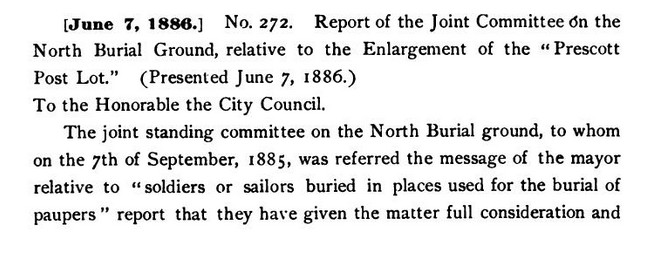
The lot the Post was given in 1871 is not the lot you are standing in. In September 1885 the Mayor sent the Council a message about soldiers and sailors "buried in places used for the burial of paupers," because a statute passed by the General Assembly that May required that the bodies of honorably discharged soldiers and sailors in pauper ground be removed from it. The Council's joint committee on the North Burial Ground reported on June 7, 1886, that the Prescott Post lot — by then described as forty feet by sixty — was "none too large" for the men the city's Grand Army posts would themselves bury there. The committee recommended enlarging it by annexing the Providence Police Association's lot next to it, and giving the Police Association a lot nearer the French monument in exchange. Moving the monument "to the centre of said lot when enlarged," with grading and turfing, was estimated at four hundred and sixty dollars. [5]
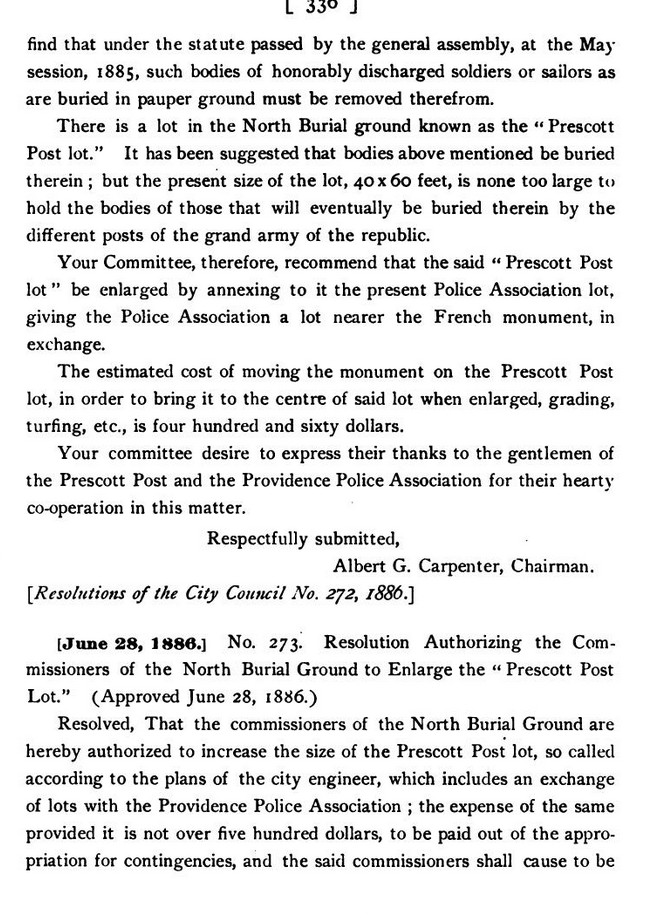
On June 28, 1886, by Resolution No. 273, the Council authorized the Commissioners of the North Burial Ground to enlarge the lot according to the city engineer's plans, including the exchange with the Police Association, at a cost of not more than five hundred dollars. [6] The monument was moved to the centre of the enlarged lot, where it stands now, and the men taken up from the pauper grounds that year were buried in the rows around it. How that reshaped the lot is told on the plot page.
The stones around it
At a later date the Council took up the headstones themselves. Alderman Reynolds introduced, and the Council passed, a resolution appropriating $1,050 "for the removal of the head stones now standing on Prescott Post lot in the North Burial Ground, and the setting up of suitable markers at the head of each grave," and authorizing the Commissioners to increase the size of the lot. [7] The date of that resolution has not yet been fixed; it is the likeliest origin of the uniform rows of small government stones that fill the lot today, but that is a question to settle, not a finding.
What we don't know
- Which gun it is. The Act of Congress names no piece. Guns of the period commonly carry a foundry mark, a registry number, a year and a weight on the trunnions, breech or muzzle. The upright gun has not yet been examined for markings; a close photograph of every face that can be reached, and of the muzzle from a ladder, is the first step. The weight the newspaper gave, 7,530 pounds, should match a stamped weight if one survives.
- Where it came from. The War Department's letter delivering the gun, and the arsenal or navy yard it was drawn from, would be in the records of the Chief of Ordnance (National Archives, RG 156). They have not been searched.
- Who cut the base. The newspaper names the granite as Westerly's but not the firm that cut it or set the gun. The Post's building committee report, as printed, does not say either.
- The deed. Resolution 287 required the lot to be deeded to the Post. The deed, and whether the Post ever held title or the City retained it, has not been found.
- When the headstones were replaced. The Reynolds resolution is undated in the clipping we hold. The newspaper and year need to be identified from the clipping's source, and the resolution found in the Council's printed records.
- What stood here before 1886. The monument was moved; the first lot was fifty by fifty, then forty by sixty. Where it stood in the original lot, and whether any graves of 1876–1886 were disturbed by the move, is not known.
The records
The images above, in order:
- Monument inscription, 2026 — the cut face of the base, photographed 2026. [1]
- Resolution No. 287, December 21, 1871 — setting off a lot in the North Burying Ground for the Grand Army of the Republic. [3]
- Public Act No. 127, June 10, 1874 — the Act of Congress granting one condemned cannon to Prescott Post. [4]
- Report No. 272 (head), June 7, 1886 and Report No. 272 and Resolution No. 273 — the enlargement of the lot and the moving of the monument. [5] [6]
The two newspaper reports are cited below and linked where a public copy exists; their images are not hosted here.
Sources
- Monument inscription, Prescott Post lot, North Burial Ground, Providence, R.I. Photograph by Bernard Brennan, 2026 (IMG_2584).
- "The Laureled Dead: Annual Observance of Decoration … At North Burial Ground," Providence Morning Star, May 31, 1875, p. 1, including the "Report of the Building Committee" read by Major E. C. Pomroy. ⟨BB: confirm title, page and column from the clipping's source, and whether a public copy exists to link⟩
- City of Providence, City Council, Resolution No. 287, "Resolution to set off a lot in the North Burying Ground for use of the Grand Army of the Republic," approved December 21, 1871; as printed in the compiled record of town and city acts relating to the North Burial Ground. ⟨BB: title, publisher and date of the compiled volume from which these pages are taken⟩
- An Act granting one condemned cannon to Prescott Post No. one Grand Army of the Republic for the erection of a monument at Providence, Public No. 127, approved June 10, 1874, 43rd Congress, 1st Session; Statutes at Large ⟨volume 18, page to be confirmed⟩.
- City of Providence, City Council, "Report of the Joint Committee on the North Burial Ground, relative to the Enlargement of the 'Prescott Post Lot,'" Albert G. Carpenter, chairman, presented June 7, 1886; Resolutions of the City Council No. 272, 1886; as printed in the compiled volume cited in note 3, p. 330. ⟨page number is clipped in our copy: 330 or 336; confirm⟩
- City of Providence, City Council, Resolution No. 273, "Resolution Authorizing the Commissioners of the North Burial Ground to Enlarge the 'Prescott Post Lot,'" approved June 28, 1886; as printed in the compiled volume cited in note 3, p. 330.
- Untitled report of City Council proceedings, resolution introduced by Alderman Reynolds appropriating $1,050 for the removal of headstones on the Prescott Post lot and the setting of markers; newspaper clipping in the project files. ⟨BB: newspaper, date and page⟩
- Rhode Island General Assembly, act of the May session, 1885, requiring the removal of honorably discharged soldiers and sailors from pauper burial ground; as described in note 5. ⟨Add the statute citation from Acts and Resolves, May 1885⟩