How to help
About three hundred Union veterans lie in this lot. We are trying to learn who each of them was, from the records, and to put what we learn at the stone where a visitor can read it. Most of the work is still ahead of us. Three kinds of help make the most difference.
1. Photograph the stones
The lot has 318 surveyed positions. We have read a name on 113 stones and photographed 95 of them. About 154 stones have not been read at all — most were recorded only by the state of service carved at the top. A clear photograph of any one of them, with its grid position, is new knowledge. 4 markers (D12, D13, D19, M2) are sunk with no inscription read at all; photograph them as they are and tell us how far they are buried.
Every photograph must come with its grid position: the row letter and column number from the plot map. Row A is the uphill row; A1 is its western end, the top-left stone on the plan. Put it in the filename (F5_2026-11-08.jpg) or in a note with the upload. If you are not sure, photograph the neighbouring stones as well and we will work it out.
How to shoot:
- Straight on, filling the frame; then a second, wider shot showing the stone in its row.
- Soft light is best: an overcast day, or early morning or late afternoon when the sun rakes across the letters. Full midday sun flattens them.
- Brush grass aside by hand if it covers letters.
- Please do not dig, pull turf, scrub, chalk, or put anything on a stone. If a stone is sunk or overgrown, photograph it as it is and tell us. The City's cemetery staff will clear it properly.
- Add your name so we can credit you.
Stones we have no photograph of
- B1 — Daniel W. Deane
- B17 — William L. Johnson
- B21 — Edward Walker
- B25 — John G. Homan
- C1 — Charles A. Jackson
- C23 — Theodore Williams
- C24 — William I. Butler
- D1 — Thomas McGraw
- D4 — Joseph R. Parker
- D7 — Adam D. Lee
- D8 — Jeffrey Mackbee
- D9 — Joseph Devendor
- D10 — Charles H. Stratford
- D14 — Jacob White
- D15 — James E. Johnson
- D16 — Polk
- D20 — Tafft
- G11 — Henry Hunter
Stones to photograph again
Our photograph of each of these leaves something unread — a buried date line, a sunk marker, a weathered word. A better angle, better light, or a visit after the grass is cut may settle it.
- A4 — Charles F. Latham date line under fallen leaves
- C14 — ISRAEL JACKSON date line below ground
- E1 — Lonzo H. Knight month of death under earth
- E3 — WILLIAM BURROUGHS lower half of the stone under earth; no date
- E4 — [JOH]N LAMBERT given name and date under earth
- E5 — THEODORE MACE year of death worn
- E6 — BARTLETT B. MATTHEWS unit and date under earth
- E8 — [???]R M[c]KENNEY photographed in hard shadow, mostly buried; the name itself is uncertain
- E9 — Benjamin Ringgold right half of the stone under earth; rank and date not visible
- E10 — Jeremiah three-quarters under earth; only JEREMIAH exposed
- E11 — CHARLES H. SAN[D]ER[S] right half under earth; surname read with reservation
- E12 — Sylvanus Green day and year of death partly unread
- E13 — HENRY FRAWLEY the middle regiment's number reads 42 or 47
- E14 — EDWARD GERALD year of death under grass
- E15 — JAMES A. L[?????] surname under earth; only JAMES A. L exposed
- E16 — GEO. C. CARL only the name line exposed
- E17 — [CHA]RLES A. DEXT[ER] only the name line exposed
- E19 — WILLIAM W. [??????] surname under a flag when photographed
- E20 — JOHN VANYEA date line under earth
- E22 — [JOH]N H. SPENCER mostly under earth
- E23 — IRA SMITH lower half under earth
- E24 — WILLIAM A. LEWIS date under grass
- F5 — Benjamin F. Williams last digit of the year illegible
- F16 — William Burr month and year partly unread
- I2 — Gibbs badly worn; given name unread
- I6 — [HENR]Y C. DIGGS given name partly unread
- I9 — PHILIP HARRIS year of death illegible
- I21 — CHARLES H. SMITH last digit of the year illegible
- I23 — JOHN H. BARNETT year of death illegible
- J2 — ORRIN VROMAN day of death reads 14 or 15
- K2 — Thomas George last digit of the year under grass
- L20 — JOHN GIBBS day and year of death illegible
- L24 — [AM]BROSE C[LARK] stone partly buried; first letters of the name and the date line
- M4 — THOMAS B. BAR[BER] marker half-buried; company letter and date line
- M5 — BENJ. G. GARDINER date line not read
- M8 — JOHN H. EASTON lower line weathered
- M10 — EDW. CRUTCHFIELD no date line visible; is there one below ground?
- M11 — WILLIAM W. WALLEY date line not read
- M15 — WILLIAM WALKER last digit of the year illegible
- M23 — JAMES B. BERRY year of death illegible
- N3 — PVT. JOEL HOLBROOK month and day of death in shadow
- N15 — MICHAEL McELROY month of death partly hidden by grass
- A17 — NATHANIEL MOSELEY position in the row inferred from the date sequence; confirm the stone is at A17
- N9 — CHARLES H. GARDNER position in the row inferred; confirm the stone is at N9
A stone photographed but not yet placed
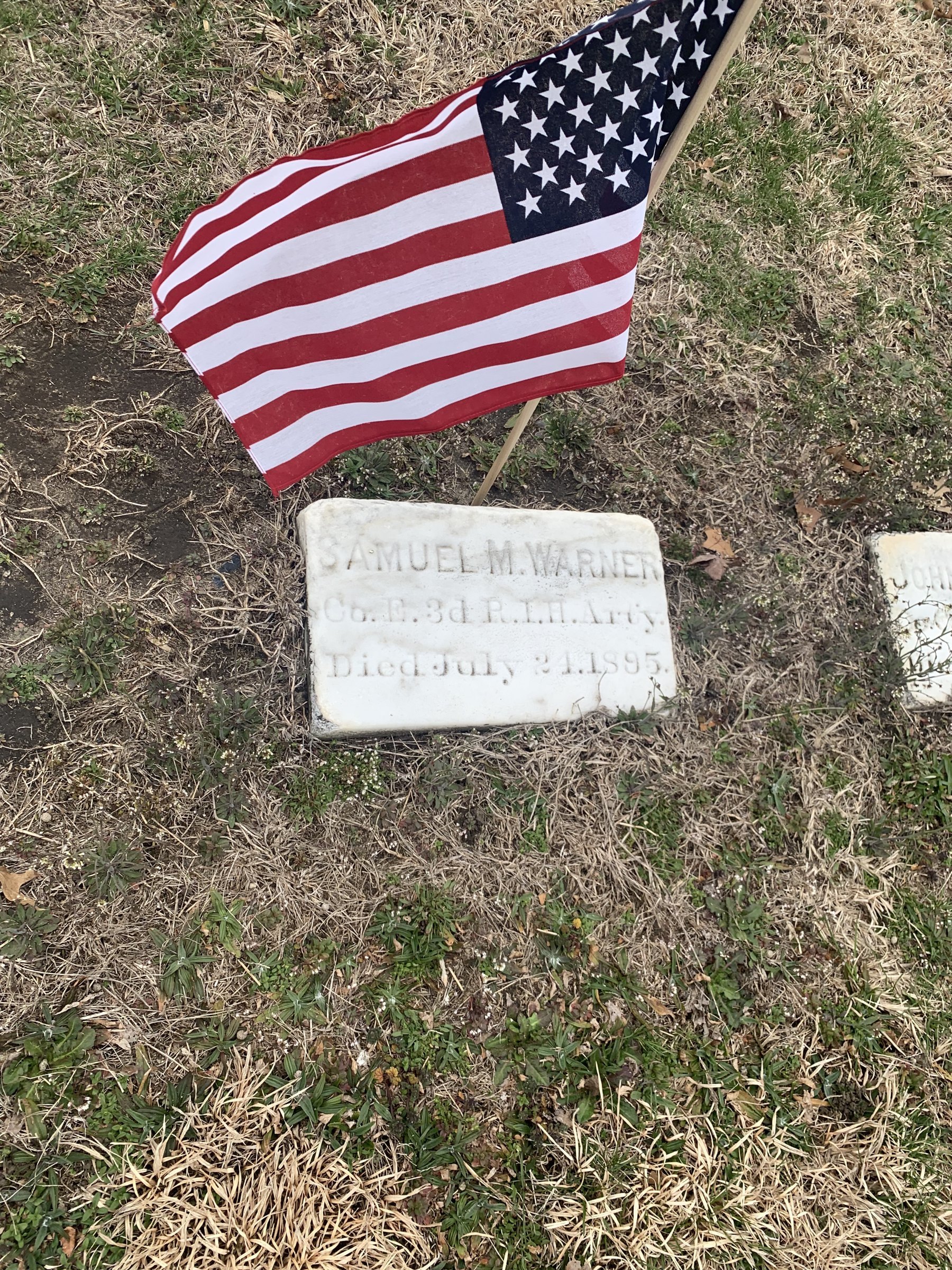
- Samuel M. Warner — Co. E, 3d R.I. Heavy Artillery, died July 24, 1895. Photographed April 2, 2024, from a distance; the stone to its right begins JOH…. A death in 1895 belongs with row J. He is not on the survey sheet. If you can stand at the stone and tell us its row and column, that settles it.
2. Find a record of a man
Each man's page ends with an Upload a record button. It takes a census page, a pension card, a city-directory entry, a newspaper item, a photograph, a family story — anything that shows who he was. You do not need an account. With each file, tell us what it is, where you found it, and why you believe it is this man: a matching name is not a matching man, and that reasoning is the most valuable thing you can give us. Every contributor is credited on the page.
- A1 — Elijah E. Ferrin
- A2 — George C. Woodbury
- A3 — James K. Weston
- A4 — Charles F. Latham
- A5 — John H. Lemons
- A6 — J. EDWARD BROWN
- A7 — Henry C. Childs
- A9 — ISAAC GRANDY
- A10 — Newton H. Briggs
- A11 — Lewis O. Dean
- A12 — JAMES CHERRY
- A13 — Edward S. Simpson
- A14 — William T. Fry
- A15 — Arthur A. Claus
- A16 — Robert Crossley
- A17 — NATHANIEL MOSELEY
- A18 — Charles W Dewey
- A19 — ALEXANDER JONES
- B1 — Daniel W. Deane
- B7 — CHARLES F. QUEEN
- B17 — William L. Johnson
- B21 — Edward Walker
- B25 — John G. Homan
- C1 — Charles A. Jackson
- C14 — ISRAEL JACKSON
- C23 — Theodore Williams
- C24 — William I. Butler
- D1 — Thomas McGraw
- D4 — Joseph R. Parker
- D7 — Adam D. Lee
- D8 — Jeffrey Mackbee
- D9 — Joseph Devendor
- D10 — Charles H. Stratford
- D14 — Jacob White
- D15 — James E. Johnson
- D16 — Polk
- D20 — Tafft
- E1 — Lonzo H. Knight
- E2 — BENJAMIN W. FOSTER
- E3 — WILLIAM BURROUGHS
- E4 — [JOH]N LAMBERT
- E5 — THEODORE MACE
- E6 — BARTLETT B. MATTHEWS
- E7 — RICHARD PIERCE
- E8 — [???]R M[c]KENNEY
- E9 — BENJAMIN RINGGOLD
- E10 — Jeremiah
- E11 — CHARLES H. SAN[D]ER[S]
- E12 — Sylvanus Green
- E13 — HENRY FRAWLEY
- E14 — EDWARD GERALD
- E15 — JAMES A. L[?????]
- E16 — GEO. C. CARL
- E17 — [CHA]RLES A. DEXT[ER]
- E18 — JAMES H. CHAFEE
- E19 — WILLIAM W. [??????]
- E20 — JOHN VANYEA
- E21 — CHARLES L. RUMENAPP
- E22 — [JOH]N H. SPENCER
- E23 — IRA SMITH
- E24 — WILLIAM A. LEWIS
- E25 — Joshua F. Hammond
- F5 — Benjamin F. Williams
- F8 — Edward Silvey
- F16 — William Burr
- F19 — CHARLES SNYDER
- F22 — John A. Jenkins
- G2 — JAMES UPSHAW
- G3 — ZEBEDEE HOWLAND
- G11 — Henry Hunter
- G14 — Theodore H. Jackson
- H15 — Joseph N. Chase
- H20 — George H. Black
- I1 — JAMES M. CLARK
- I2 — Gibbs
- I6 — [HENR]Y C. DIGGS
- I9 — PHILIP HARRIS
- I21 — CHARLES H. SMITH
- I23 — JOHN H. BARNETT
- J1 — HENRY B. WILLIAMS
- J2 — ORRIN VROMAN
- J4 — MARSHALL KING
- J6 — HENRY N. WELCH
- J7 — Robert Lewis
- J15 — Emanuel Parker
- K2 — Thomas George
- K4 — JOSEPH HOVEY
- K6 — ROBERT S. JOHNSON
- L20 — JOHN GIBBS
- L24 — [AM]BROSE C[LARK]
- M4 — THOMAS B. BAR[BER]
- M5 — BENJ. G. GARDINER
- M8 — JOHN H. EASTON
- M10 — EDW. CRUTCHFIELD
- M11 — WILLIAM W. WALLEY
- M15 — WILLIAM WALKER
- M20 — DENNIS D. BURGESS
- M23 — JAMES B. BERRY
- N1 — ASA A. ANDREWS
- N2 — WILLIAM McCLOUD
- N3 — PVT. JOEL HOLBROOK
- N4 — OLIVER COGGESHALL
- N5 — WILLIAM G. BAKER
- N6 — GEORGE W. STODDARD
- N7 — SAMUEL E. WHITE
- N8 — JOHN S. BROWN
- N9 — CHARLES H. GARDNER
- N10 — JOSEPH S. CASSEN
- N11 — OTHELLO W. GODFREY
- N12 — ISAAC E. POTTER
- N13 — HENRY J. GEER
- N14 — JEREMIAH DUPONT
- N15 — MICHAEL McELROY
3. Tell us if you are family
If you are descended from a man buried here, or know someone who is, please say so when you upload, or write to us. We do not publish a page about a man whose descendants we know of without talking to them first, and family papers and memory are often the only route past what the government wrote down.
What happens to what you send
Uploads go to a holding folder that only the project's researchers can see. We read each file, check the identity, and record where it came from. Records we can host — National Archives files, City of Providence records, your own photographs — go on the man's page with a caption and a citation. Records from subscription sites are cited and linked, not copied. Nothing is published without a source.
Questions: Bernard Brennan, bbrennan@jwu.edu.